
A Teacher’s Guide to Evolution, Behavior, and Sustainability Science
Our interdisciplinary teacher’s guide outlines our educational design concept. It provides introductory readings around core concepts of human sciences and ideas for exploring them in the classroom.

Agriculture and domestication
Resources and information about the evolution of agriculture and domestication
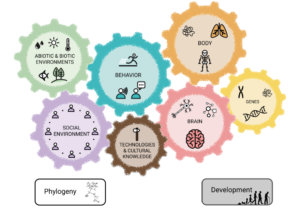
Blackboard materials: Causal maps on human evolution
Materials for constructing causal maps about the evolution of human traits on the blackboard
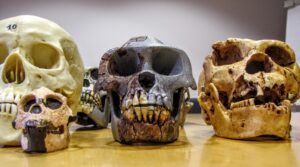
Brain size
Teaching resources and information about the evolution of human brain size
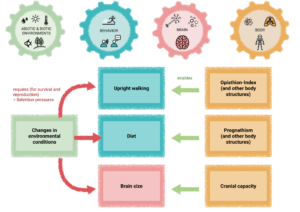
Causal map materials for skull morphology and related traits
Materials for constructing an initial causal map relating observable features of fossil hominin skulls, behaviors, and environmental conditions
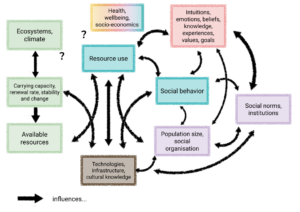
Causal mapping pieces for causal relationships in the present and future
Materials for creating a causal map on the relationships between human behaviors, technologies, institutions, social and natural environments
Causal maps on the evolution of human traits
All causal maps on human evolution in one Google slide file

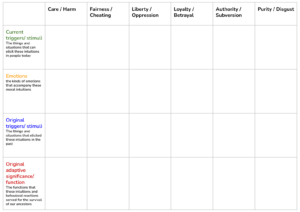
Causes of our moral intuitions
In this lesson students explore the causes of our moral intuitions with the help of a sorting activity and reflection questions.
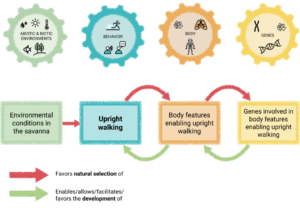
Chalkboard materials: Causal map on upright walking
Chalkboard materials for constructing a causal map for the evolution of upright walking
Childhood, teaching, learning
Resources and information about the evolution of childhood, teaching, and social learning
Connecting Past, Present, and Future
A collection of materials for connecting past human evolution to the present and the future. Students explore global trends and relationships between human behavior, technologies, social organization, environment, and well-being.
Connecting the past, present, and future – Education
Information about the history of education
Connecting the past, present, and future – Food production
Information about the history and current challenges of food production
Connecting the past, present, and future – Technologies
Information about the history and future of technologies

Constructing a phylogenetic tree of languages
In this lesson, students use linguistic data (word similarities between languages) to reconstruct a phylogenetic tree of related languages and use the tree to infer the specific relationships between languages.
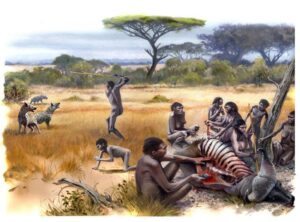
Cooperative foraging
Information and teaching resources on cooperative foraging in human evolution
Cultural evolution
Teaching resources and information about cultural evolution

Cultural evolution (lesson plan)
Students explore the concept of cultural evolution by comparing it to genetic evolution based on a number of concepts, and explore why cultural evolution is so important in our species.
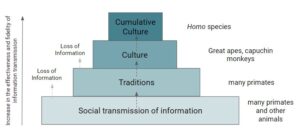
Cumulative culture
Teaching resources and information about the evolution of cumulative culture

DNA-V
Psychologists Louise Hayes and Joseph Ciarocchi have developed the DNA-V model. It contains the metaphors of the “Discoverer“, “Noticer“, “Advisor” and the “Valuer”, to help humans be aware of, make use of, and practice different skills towards valued living.
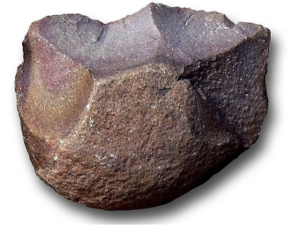
Early stone tools
Teaching resources and information about the origins of stone tool use and making
Embracing Complexity
A guide to exploring the mind in educational settings through evolutionary and behavioral science
Endurance Running
Teaching resources and information about the evolution of endurance running
Evolution, Cooperation, and Sustainability
A lesson collection on evolution, cooperation, and sustainability

Evolutionary Anthropology for interdisciplinary biology education – teaching materials collection
A collection of teaching materials for the book “Evolutionary Anthropology in interdisciplinary biology education”

Evolutionary Anthropology in the Primary School
Evolutionary Anthropology in the Primary School – a pre-service primary teacher module
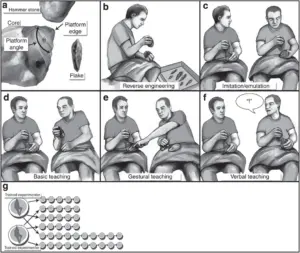
Experiment on the the co-evolution of tool making, teaching, and language
An experiment in which researchers wanted to examine the role of teaching and communication in the transmission of toolmaking.
Fast and slow thinking
Teaching resources and information about the evolution of fast and slow thinking
Fill in the blanks: adaptations to cooperative foraging
A fill in the blanks activity on the natural selection of traits that enabled cooperative foraging in our ancestors
Function of cognitive biases
In this lesson students learn about the concept of cognitive biases as well as a number of important cognitive biases that may affect our well-being and social interactions, identify their causes in evolutionary history, their functions, and reflect on how to cope with cognitive biases.
Gene-Culture Co-Evolution
Information about gene-culture coevolution
Handout: Introduction to causal maps with the example of upright walking
A handout that introduces students to the causal map to map the evolution and development of traits, with the example of upright walking
Hominin skull measurement Google sheet for data entry and analysis
Google sheet template for entering and plotting the measurements of hominin fossil skulls
Hominin skull measurement instructions
Instruction sheet for measuring cranial capacity, opisthion index and prognathism on fossil hominin skulls
Human Behavior & Sustainable Development
A lesson collection for the Human Behavior & Sustainable Development module.
Human evolution – Gesturing and shared attention
Teaching resources and information about the evolution and significance of gesturing and shared attention in our species
Human Evolution – Hominins
Teaching resources and information about fossil hominins
Human evolution – Human needs, values, and wellbeing
Classroom resources for exploring (the evolution of) human needs, values, and well-being
Human evolution – Life in groups
Teaching resources and information about origins of human adapatations to life in groups
Human evolution – Life with other groups
Teaching resources and information about the impact of intergroup cooperation and competition in human evolution
Human evolution – Symbols and language
Teaching resources and information about the evolution of human language and symbolic thinking
Human evolution – Throwing and body coordination
Teaching resources and information about the evolution of throwing abilities
Human evolution – Upright walking
Information and teaching materials on the evolution of upright walking in our species
Human Evolution Resources
Our collection of resources for learning about human origins and evolution
Lesson plan: Evolution and development of upright walking
This document contains a collection of activities and resources related to the evolution and development of upright walking in our species
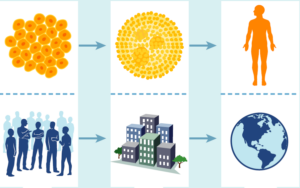
Life in groups and conflict resolution
A reading text about the challenges of life in groups and how groups across biology have found ways to solve these challenges.
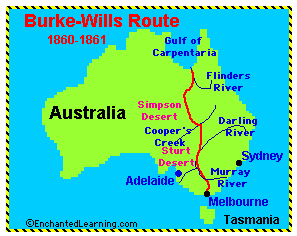
Lost explorers
Stories of lost explorers that tell us about the importance of cultural knowledge to our survival.
Mental Time Travel
Teaching resources and information about the evolution of our capacity for mental time travel
Mismatch
Teaching resources and information for learning about the concept of evolutionary mismatch in human behavior and its potential role in sustainable development
Mismatch? (lesson plan)
Students learn about the concept of evolutionary mismatch and apply it to various problems of sustainable development.
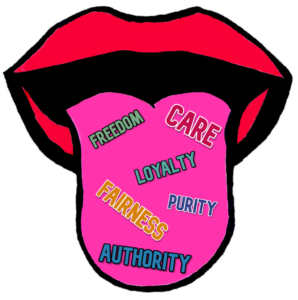
Moral taste buds
In this lesson students explore the causes and functions of, as well as ways to flexibly relate to our moral intuitions by engaging the analogy to our taste buds.
Observing differences in hominin skulls
An activity for students to explore and notice traits on fossil hominin skulls
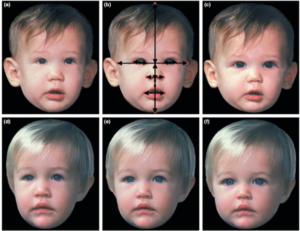
Reading text – Baby schema
A reading text on the evolution of the baby schema together with cooperative child care
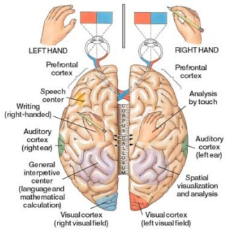
Reading text – Brain and coordination of body movements
A reading text on the evolution of left-right handedness and the role of the brain
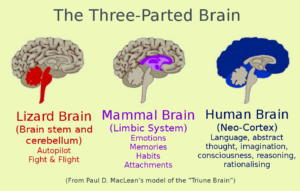
Reading text – brain areas and their functions
A handout about the “Triune Brain” model highlighting different functions of different brain regions
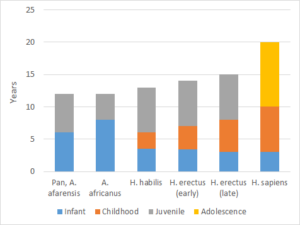
Reading text – Evolution of childhood
A reading text and causal mapping tasks on the (co)evolution of brain size, childhood, premature birth, cooperative childcare and social learning and teaching
Reading text: Cooperative foraging
A reading text about cooperative foraging in the animal kingdom and in our early ancestors
Reading text: Cumulative culture
A reading text about the importance of cumulative culture in our everyday experience and in the evolution of our species
Reading text: Tool making and human evolution
A reading text about tool use and tool making in the animal kingdom and in our early ancestors
Stone Age Hunting Game
A cooperation game that simulates the challenge of our stone age ancestors to acquire food in the African savanna
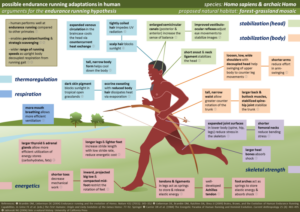
Teaching materials: Evolution of endurance running
Reading texts, videos and causal maps on the evolution of physical and cognitive traits for endurance running over the course of human evolution