

A Teacher’s Guide to Evolution, Behavior, and Sustainability Science
Our interdisciplinary teacher’s guide outlines our educational design concept. It provides introductory readings around core concepts of human sciences and ideas for exploring them in the classroom.

Agriculture and domestication
Resources and information about the evolution of agriculture and domestication
Brain size
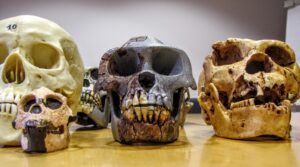
Teaching resources and information about the evolution of human brain size
Chimps or children – who is better at sharing resources?
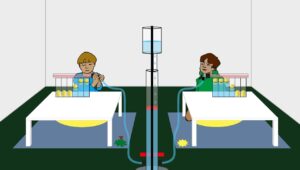
A comparative behavioral research experiment exploring the abilities of chimpanzees and of children to cooperate around a shared resource.
Connecting the past, present, and future – Food production
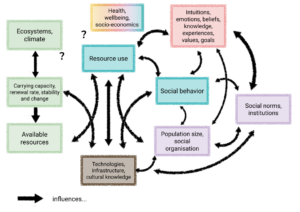
Information about the history and current challenges of food production
Connecting the past, present, and future – Technologies
Information about the history and future of technologies
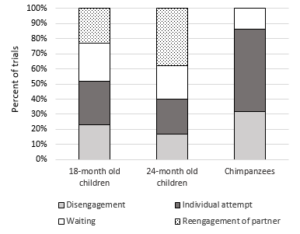
Cooperative activities with children and chimpanzees
A series of experiments with small children and chimpanzees to investigate their ability and motivation to engage in collaborative activities
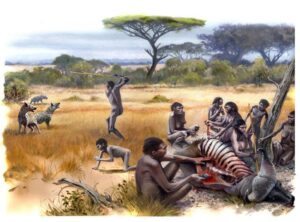
Cooperative foraging
Information and teaching resources on cooperative foraging in human evolution
Creativity and flexibility
Human Evolution Resources Creativity and flexibility Many traits are strongly influenced by genetic inheritance. Through

Early stone tools
Teaching resources and information about the origins of stone tool use and making
Evolution, Cooperation, and Sustainability
A lesson collection on evolution, cooperation, and sustainability

Evolutionary Anthropology for interdisciplinary biology education – teaching materials collection
A collection of teaching materials for the book “Evolutionary Anthropology in interdisciplinary biology education”

Evolutionary Anthropology in the Primary School
Evolutionary Anthropology in the Primary School – a pre-service primary teacher module
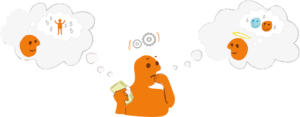
Game theory: Ultimatum and Dictator game
A set of behavioral experiments across cultures that explore the human sense of fairness.
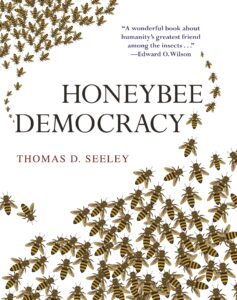
Honeybee Democracy
Students explore how a honeybee swarm makes a decision about their future nesting site, and explore the similarities and differences to how human groups make decisions.
Human Behavior & Sustainable Development
A lesson collection for the Human Behavior & Sustainable Development module.
Human evolution – Emotions
Teaching resourcen and information for exploring the evolution of emotions
Human evolution – Human needs, values, and wellbeing
Classroom resources for exploring (the evolution of) human needs, values, and well-being
Human evolution – Life in groups
Teaching resources and information about origins of human adapatations to life in groups

Imitation in chimps and children (Video, Experiment)
A series of experiments to explore the tendency to imitate in children and chimpanzees
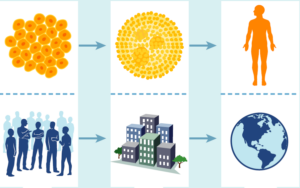
Life in groups and conflict resolution
A reading text about the challenges of life in groups and how groups across biology have found ways to solve these challenges.
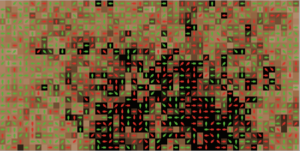
NetLogo Model: Evolution and competition for resources (abstract)
This NetLogo model lets students explore how competition for resources can affect the evolution of a population and can result in resource overuse. This model is similar to the Evolution and competition for forest resources model, but more abstract.

NetLogo: Evolution of resource use and social behavior (monitoring and punishment)
This model lets us explore how the appearance of certain social behaviors can affect evolutionary population dynamics.

NetLogo: Island World
This model simulates the evolution of populations in an environment that is spatially structured. In such a situation, several evolutionary mechanisms operate, including migration, founder effect, multilevel selection.
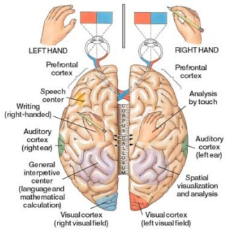
Reading text – Brain and coordination of body movements
A reading text on the evolution of left-right handedness and the role of the brain
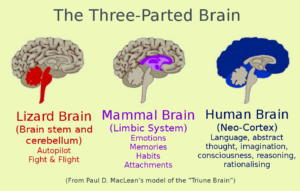
Reading text – brain areas and their functions
A handout about the “Triune Brain” model highlighting different functions of different brain regions
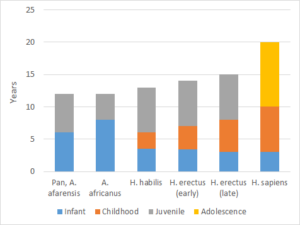
Reading text – Evolution of childhood
A reading text and causal mapping tasks on the (co)evolution of brain size, childhood, premature birth, cooperative childcare and social learning and teaching
Reading text: Tool making and human evolution
A reading text about tool use and tool making in the animal kingdom and in our early ancestors
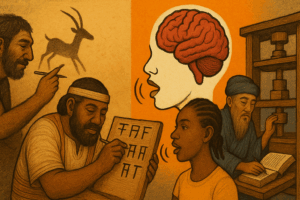
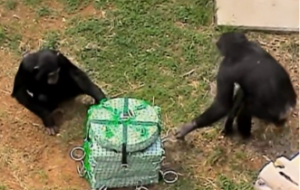
Video – Can chimpanzees coordinate their activities
In this short video, we observe how chimpanzees seem to be unable to spontaneously coordinate their activities to get food – something that humans find very easy.
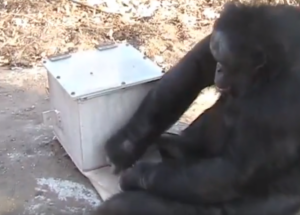
Video questions – Kanzi making and using stone tools
The bonobo Kanzi was taught to make and use simple stone tools of the Oldowan culture. What can we conclude about the mental abilities of Homo habilis from Kanzi’s performance?
Video questions: Breeding foxes and social temperament
This video is about domestication – or “taming by breeding” – of foxes, a Russian research project that has been conducted since the 1950s. It shows which behavioral patterns of foxes were selected during breeding, what was found out about the genetic makeup underlying these patterns of behavior and to what extent fox breeding is comparable to the breeding of dogs.
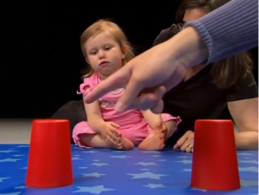
Video: the pointing gesture
A video excerpt and worksheet on the importance of pointing gestures in human communication

What Kind of Mind?
‘What Kind of Mind?’ provides teaching resources to introduce pupils to research ideas about animal minds.
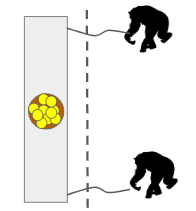
Worksheets: Cooperation experiments with chimps and bonobos
In a series of experiments, anthropologists wanted to find out whether chimpanzees and bonobos work together and share a common source of food. Results tell us something about the role of social tolerance in cooperative foraging.