Our Theory of
School Improvement

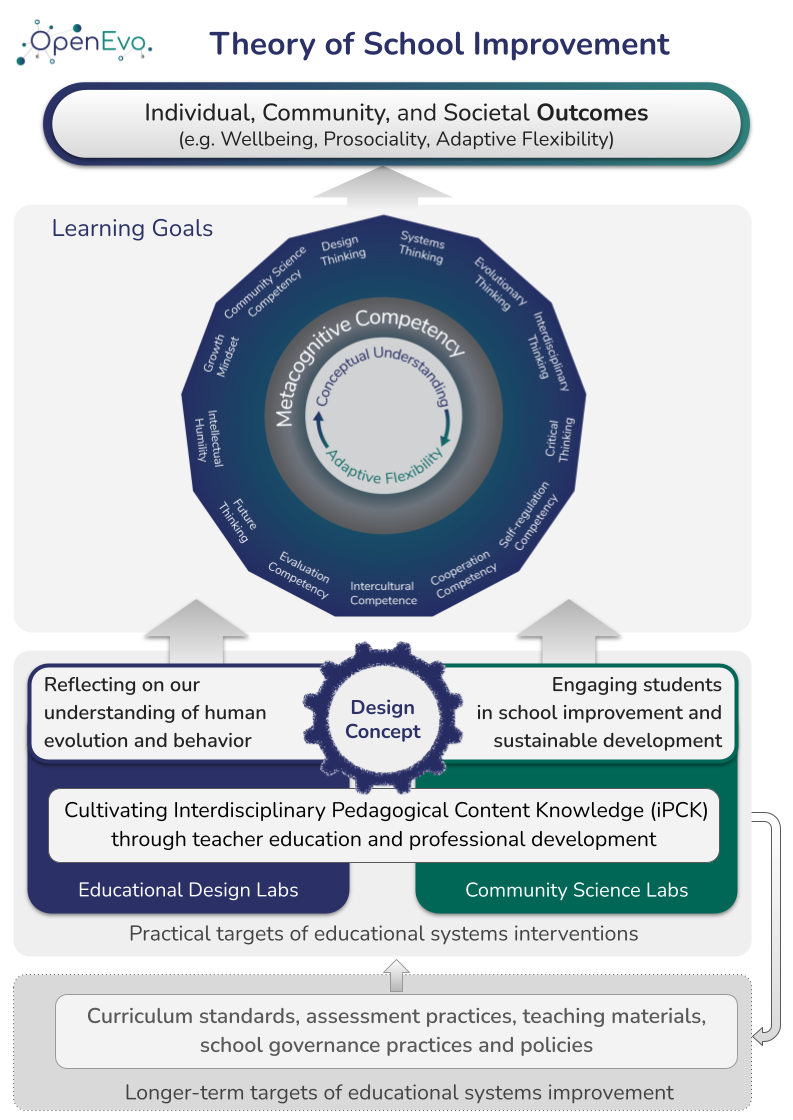
Our Theory of School Improvement provides a roadmap to our educational innovation efforts.

With our educational innovation work, we aim to cultivate a variety of competencies in learners and contribute to well-being and prosociality.

Our Theory of School Improvement serves to organize and focus the elements of our work on educational innovation towards these aims under the given context of education systems. 

Historical and modern socio-cultural factors – such as the disciplinary structure of the curriculum, issues of curriculum overload, limits to student and teacher autonomy, and standardized testing –  coalesce to make it exceedingly difficult for teachers to engage with human behavior as an interdisciplinary theme for the development of core student competencies. Human behavior seems to be “everywhere and nowhere” in the curriculum. Students might learn disconnected, maybe even fundamentally contradicting things about humans in the biology, economics, history, language, geography, or ethics classrooms.   

When it comes to understanding humans, we want to help teachers and students see the forest for the trees – to be able to critically connect and transfer disciplinary perspectives into a more coherent and helpful core, while navigating plurality, disagreement, and uncertainty.

Therefore, we target the strategic development of teaching and curriculum resources as well as interdisciplinary teacher education and professional development opportunities in order to help teachers develop their Pedagogical Content Knowledge (PCK) to teach about human behavior across traditional subject areas and grades.
With the development of these professional competencies, teachers can enable students and others to reflect on and develop their conceptual understanding of human behavior, as well as to apply their understandings towards improving their own lives and their school culture and communities.

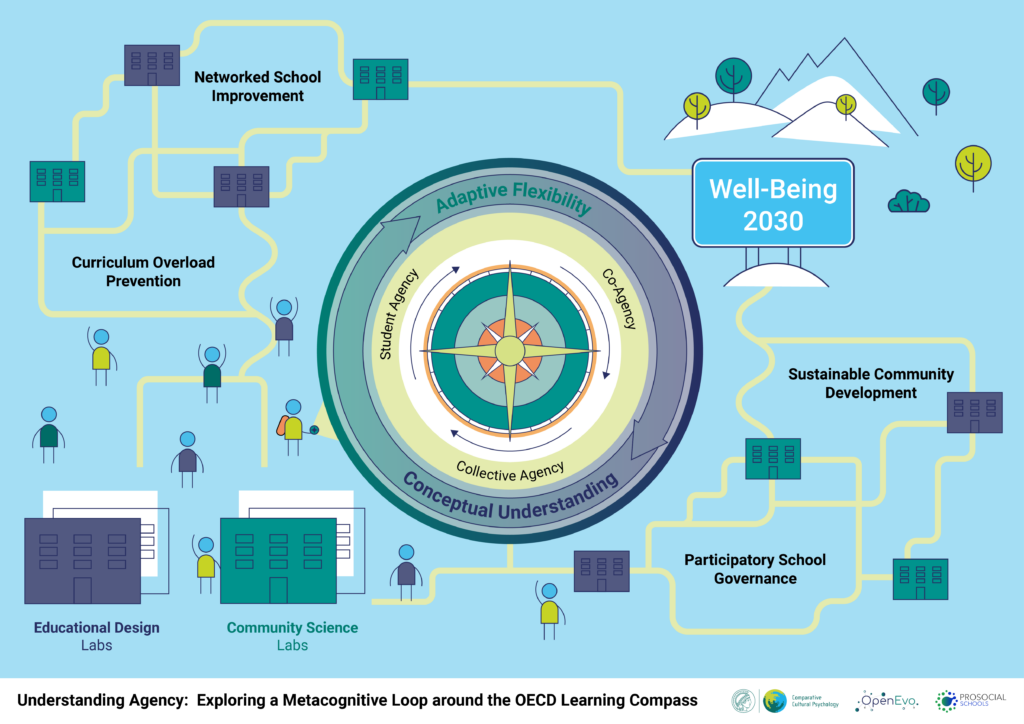
The interplay between these academic and applied learning domains can serve to further reinforce student and teacher conceptual understanding of human behavior as well as their skills for adaptive flexibility, both of which are hypothesized to be foundational in the metacognitive development of competencies.

To target these various areas of educational systems interventions, OpenEvo is building tools, methods, and infrastructure for the collaborative and networked development and evaluation of educational innovations.

Our Educational Design Lab focuses on the development of innovative materials and curricula as well as educational design guidance to teach about human behavior across subjects and grades.

Our Community Science Lab focuses on the development of tools, materials, and infrastructure to enable students to investigate and improve their own communities through the concepts and methods of behavioral science.