Interactive presentation – Constructing a phylogenetic tree of related languages
Interactive presentation – Constructing a phylogenetic tree of related languages Read More »


In this lesson, students use linguistic data (word similarities between languages) to reconstruct a phylogenetic tree of related languages and use the tree to infer the specific relationships between languages.
Constructing a phylogenetic tree of languages Read More »
This document contains a collection of activities and resources related to the evolution and development of upright walking in our species
Lesson plan: Evolution and development of upright walking Read More »
Teaching resources and information about the evolution of our capacity for mental time travel
Mental Time Travel Read More »
Teaching resources and information about the evolution of fast and slow thinking
Fast and slow thinking Read More »
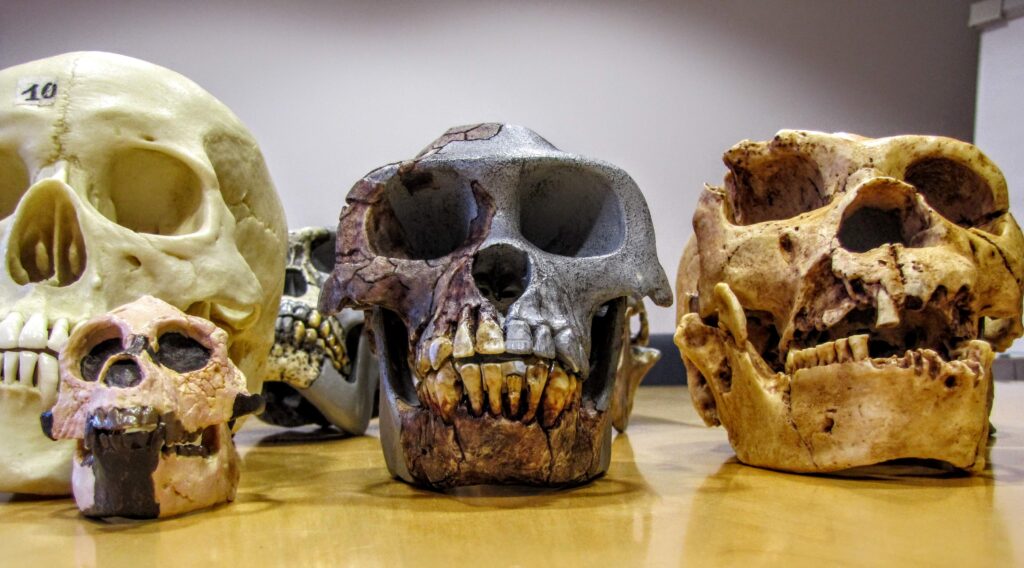
A worksheet on which students collect information on a specific fossil hominin
Worksheet: Fossil hominin fact sheet Read More »

Psychologists Louise Hayes and Joseph Ciarocchi have developed the DNA-V model. It contains the metaphors of the “Discoverer“, “Noticer“, “Advisor” and the “Valuer”, to help humans be aware of, make use of, and practice different skills towards valued living.
This activity lets students explore the six different values domains by considering why we humans might have evolved to find these areas of life meaningful and important, and what kinds of different things we can do to live towards these valued domains.
Values domains sorting activity Read More »

Students learn about the concept of evolutionary mismatch and apply it to various problems of sustainable development.
Mismatch? (lesson plan) Read More »